
CLIENT WORK / GAP REVIEW · MPA-SFE-001
Supplier failure early warning
In one line
Three million companies checked against free public records, a year before the event: what the records really tell you about a supplier that is about to go, and what they miss.
The problem
When a key supplier fails without warning, the buyer pays twice: once in disruption and again in re-procurement. Credit-scoring services are expensive and their workings are hidden. Meanwhile some of the early signs (accounts filed late, a new loan secured on the company's assets, a sudden move of registered office) sit in free records that nobody watches.
The question
Can free Companies House records flag a supplier months before it fails? How early, how many does it catch, and how many false alarms does it raise?
What I did
- Took four monthly snapshots of the whole Companies House register: April 2025, October 2025, April 2026 and October 2026. Each holds 5.6 to 5.7 million companies.
- Took every company that was active on 1 October 2025, at least two years old, trading (not dormant) and a limited company, PLC, LLP or community interest company: 2,978,246 companies.
- For each one, counted five warning signs, using only what was public on that date:
- accounts overdue
- confirmation statement overdue
- a new charge (secured debt) registered in the previous six months
- registered office moved in the previous six months
- accounts already overdue six months earlier (a repeat late filer)
- Looked at the October 2026 register to see which of them had entered liquidation, administration, receivership or a voluntary arrangement (25,366 companies), and which had been struck off altogether (157,125).
- Repeated the whole test on a later period (signs on 1 April 2026, outcome six months later) to check the results hold.
- Read the insolvency case type and start date from the public register for 300 failed companies: 150 drawn at random from the flagged ones (for lead time) and 150 at random from the rest (to see how many "failures" were in fact solvent closures, members' voluntary liquidations where the owners wind up a healthy company).
The rules were written down before the first run and not changed afterwards.
What I found
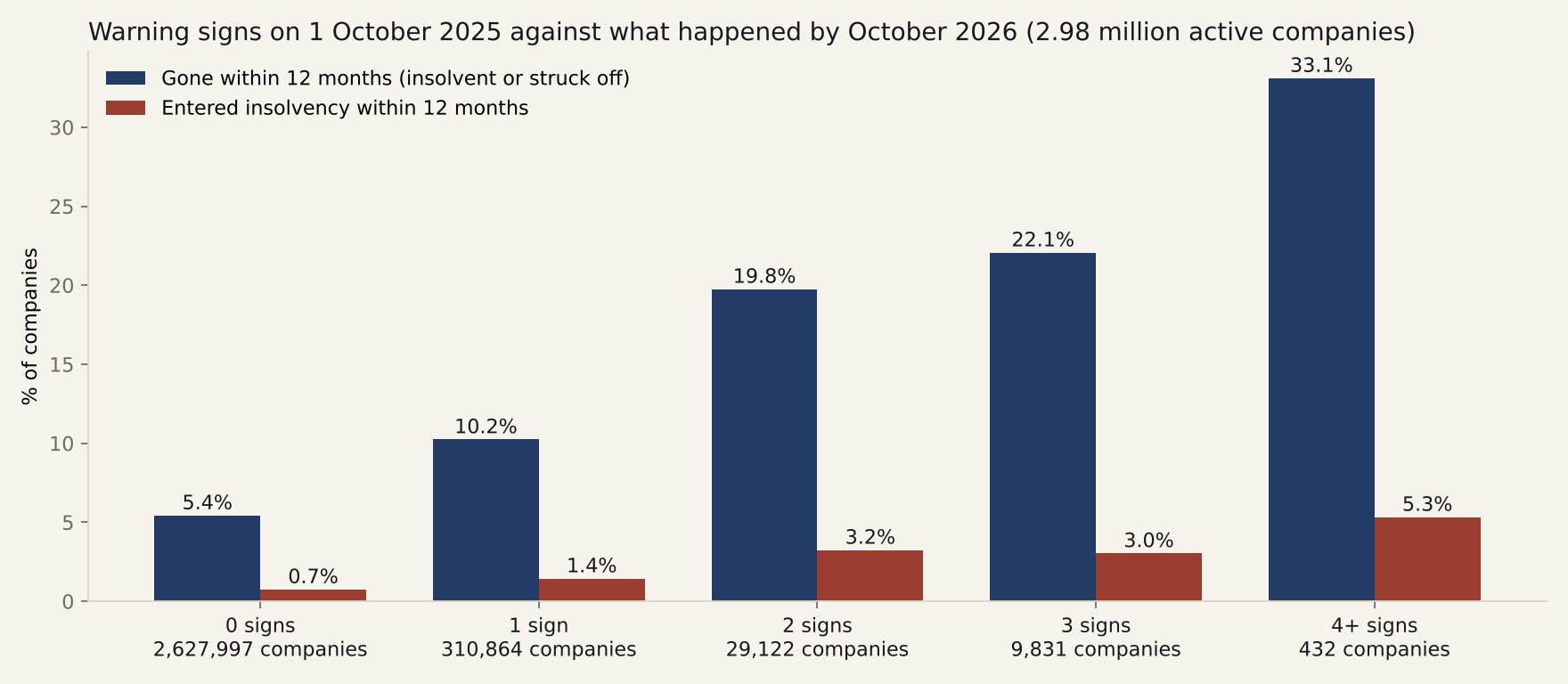
1. Two or more signs means a company is 3.5 times as likely to be gone within a year
- 1.3% of companies (39,385) showed two or more signs.
- Within twelve months, 20.5% of them had either entered insolvency or been struck off, against 5.9% of everyone else.
- On insolvency alone, after taking out solvent closures: 2.8% of flagged companies against a base rate of 0.57%, so 4.9 times the normal rate.
- The pattern holds on the second, later test period: on the same raw measure (solvent closures included), two or more signs gave 5.5 times the base failure rate over six months, against 3.8 times in the first test. The direction held and the effect was, if anything, stronger.
2. Most failures give no warning in the public record
- 77% of the companies that failed had none of the five signs a year earlier (this count includes solvent closures).
- Two or more signs caught only 6.5% of genuine insolvencies.
- For every flagged company that went insolvent, about 35 flagged companies did not.
What it means: filing behaviour is a cheap first filter, not a prediction. A company can file on time right up to the week it calls in the liquidators. Anyone selling a "free early-warning score" built only on these records is overselling it.
3. When the signs do appear, there are months to act
For flagged companies that went on to fail, the median gap between the warning date and the start of insolvency was 4.6 months. 38% failed six months or more after first showing the signs.
Live check: the council's suppliers today
The same five signs were run on 1 October 2026 against the 654 suppliers from the council spend audit (MPA-CSA-001) that could be matched to a single company and are still trading. - 10 show two or more signs, between them paid £1.05m last year. - 101 show at least one sign. - Separately, that audit had already found 21 suppliers paid £6.3m that are in insolvency now or being struck off.
Ten names is a manageable review list for a procurement team, and that is the right way to use the signs: as a short, cheap list to look at properly, not as a verdict.
What it means for a business
- Check the free signs every month, for every supplier. It costs almost nothing, and a flagged supplier is 3.5 times as likely to be gone within a year.
- Do not treat "no signs" as "safe". Three quarters of failures are silent in the filing record. For suppliers you could not easily replace, you need their accounts (cash, debt, losses), payment behaviour and their own customers' health.
- Keep the supplier master file clean. The council audit showed the bigger risk can be paying a company that has already failed, or paying under the name of a company that stopped filing years ago.
How I would run this for a client
- What you provide: your supplier list with company numbers (or names and postcodes, which I match), the spend with each, and which ones are critical.
- What you get: a monthly flagged list with the reason for each flag, a ranked review of your critical suppliers using their filed accounts as well as the signs above, and a short note on what to do about each one.
- How long: two weeks to set up, then a monthly run. Fixed fee, agreed when we scope it.
Limits
- Filing behaviour only. The free bulk register does not include accounts figures, director changes or County Court Judgments, all of which would make the signs sharper. Director resignations were in the original plan and had to be dropped for this reason.
- "Failed" comes from the company's status a year later. The share of solvent closures was estimated from samples of 150, not counted for every company: 33% of failures among unflagged companies, 13% among flagged ones.
- Community interest companies were included alongside limited companies, PLCs and LLPs; the written rules named only the last three. Leaving them out makes no material difference to a population of three million.
- Some companies were already starting insolvency on the warning date before their status changed on the register (8% of the flagged sample). This flatters the lead time slightly for that group.
- Companies that failed and were dissolved within the year drop out of the register altogether and are counted as struck off, not failed.
- Sole traders and partnerships are not on Companies House.
Hostile self-audit
- "Isn't a 4.9× lift impressive?" It is real, but it applies to only 1.3% of companies and catches only 6.5% of insolvencies. The note leads with both numbers, not just the flattering one.
- "Counting struck-off companies as 'gone' inflates the result." It is reported separately and clearly labelled. For a buyer, a supplier struck off is still a supplier lost.
- "Solvent liquidations aren't failures." Agreed. They were measured on a sample and taken out of the insolvency figures.
- "Did you pick the signs that worked?" The five signs and the thresholds were set before the run. The results include the disappointing ones: in the first test three signs did no better than two (in the second they did somewhat better).
- "Would the result hold in another year?" It was rerun on a later, shorter period. The direction held and the lift was larger, but the two periods are of different lengths, so the sizes are not directly comparable.
Sources
- Companies House Free Company Data Product, monthly snapshots of 1 April 2025, 1 October 2025, 1 April 2026 and 1 October 2026: https://download.companieshouse.gov.uk/en_output.html
- Insolvency case type and start date for 300 sampled companies, from the public Companies House service: https://find-and-update.company-information.service.gov.uk/
- Council supplier list and spend: project MPA-CSA-001
No company is named on the public site.