
CLIENT WORK / MARKET ANALYSIS · MPA-LPR-001
Who pays their suppliers late
In one line
Every large-company payment report since 2017, about 98,000 of them, joined to sector: who makes suppliers wait, who is getting slower, and what it costs a small firm in cash.
The problem
Late payment drains small firms' cash, and some of them fail because of it. Large UK companies must publish how fast they pay their suppliers every six months. The reports sit in a government register that almost nobody analyses across companies or over time.
The question
Which sectors and which large buyers pay slowest? Who is getting worse? What does a slow payer cost a small supplier in hard cash?
The data
- The register: the full export of the Payment Practices and Performance register, downloaded 9 October 2026. 115,428 reports.
- Cleaning: 97,578 reports were kept, covering 9,334 companies. Taken out were reports with no payments, average days outside 1 to 365, and impossible percentages.
- Sector: each company's first SIC code on the Companies House register; 95% matched.
- A change in the rules: for financial years starting on or after 1 January 2025, companies must also report the value of invoices paid late. Days to pay and the percentage bands did not change, so those are compared over time.
The rules were written down before the run.
What I found
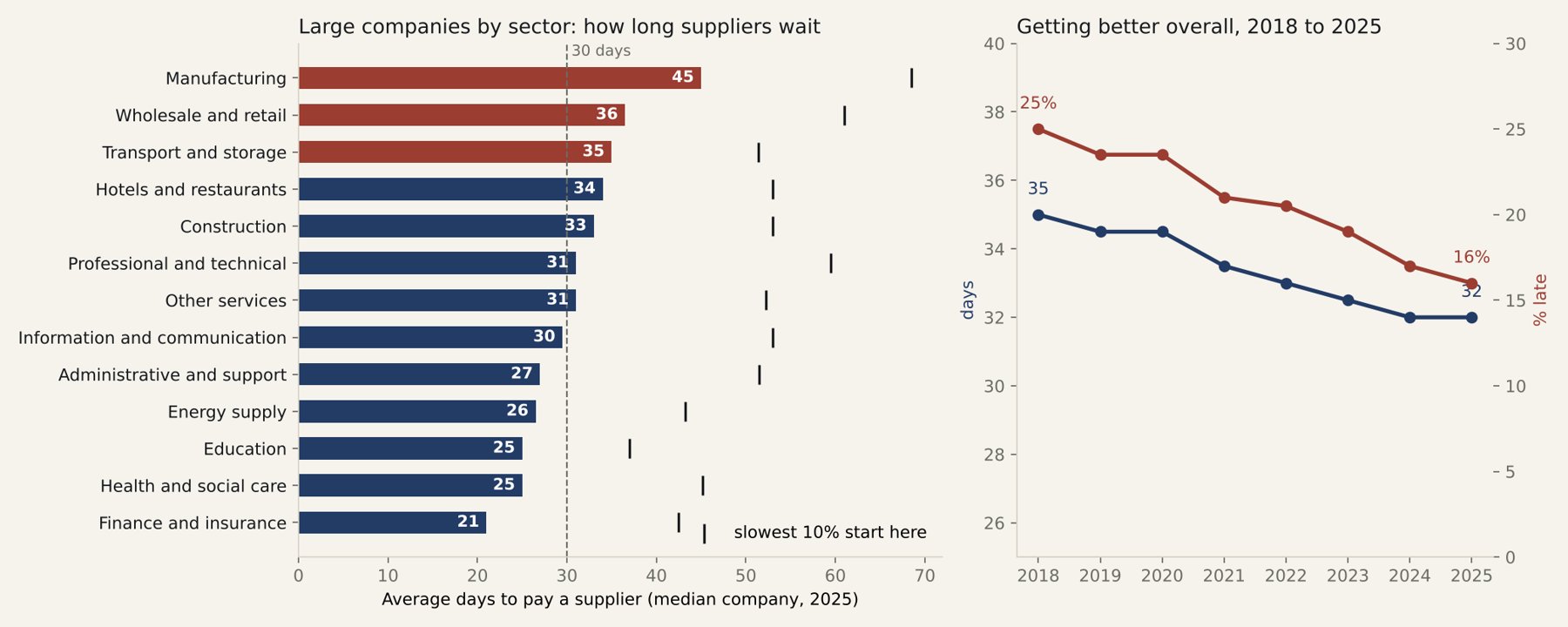
1. Manufacturing makes suppliers wait more than twice as long as finance
2025 reports, median company in each sector (a selection; all 13 sectors with 100+ companies are in the league table file):
| Sector | Median days to pay | Slowest 10% at or above | Paid within 30 days |
|---|---|---|---|
| Manufacturing | 45 | 68.5 | 31% |
| Wholesale and retail | 36.5 | 61 | 46% |
| Transport and storage | 35 | 51 | 55% |
| Construction | 33 | 53 | 56% |
| Professional and technical | 31 | 59.5 | 68.5% |
| Education | 25 | 37 | 82% |
| Finance and insurance | 21 | 43 | 86% |
- Across all 6,147 large companies reporting for 2025, the median is 32 days and 64% of invoices are paid within 30 days.
- Nearly one in five large manufacturers (19%) takes more than 60 days on average.
2. Better overall, but one company in ten is getting steadily slower
- Nationally things have improved since 2018: median days to pay fell from 35 to 32. The share of invoices paid later than agreed fell from 25% to 16%.
- But 531 companies have got steadily slower. These are 10.6% of the 4,997 that reported every year from 2022 to 2025. Their median went from 31.5 days to 45.
- Slightly fewer (445) improved by the same measure.
- Where the slow-downs are: led by manufacturing (88) and wholesale and retail (81).
What it means: the national average hides a group of big buyers moving the wrong way. For a supplier, the trend of a particular customer matters more than the sector average.
3. What a slow payer costs a small supplier
Take a small firm selling £1m a year to one large customer, borrowing at 7.75% (Bank Rate of 3.75% plus a typical small-business margin of 4%):
| Customer | Days to pay | Extra money tied up vs a 30-day payer | Extra cost a year |
|---|---|---|---|
| Median large company | 32 | £5,500 | £425 |
| Slowest 10% overall | 57 | £74,000 | £5,700 |
| Median manufacturer | 45 | £41,000 | £3,200 |
| Slowest 10% of manufacturers | 68.5 | £105,000 | £8,200 |
For a small firm making a 5% margin, £8,200 is the profit on £164,000 of sales, handed over for nothing more than waiting.
4. What the new value figures show, and why they cannot be taken at face value
Under the 2025 rules, the median large company paid 14% of its invoice value late against its own terms. A third of reports show more than a quarter of the value paid late.
The register's money totals cannot be summed with confidence, though. One six-month report claims £246bn of supplier payments, more than the annual turnover of almost any UK company. Others are similarly out of scale. The figures are self-reported and unaudited, and some are plainly mis-keyed. That is a finding in its own right: nobody checks this register.
What it means for a business
- If you supply large companies: check a customer's own record on the register before agreeing terms, and price in the wait. Two customers at 45 and 68 days are worth very different amounts to you.
- If you are a large buyer: your record is public and comparable. If you are getting slower while your sector improves, a supplier, a lender or a journalist can see it.
- If you lend to small firms or buy their invoices: the register gives a free measure of how long each debtor actually takes to pay.
How I would run this for a client
- For a supplier or lender: a debtor check of your customers against the register, with the cash cost of each and a watch list of those getting slower.
- For a large buyer: a comparison with your sector and your direct competitors, plus a check of your own figures before you file.
- How long: one to two weeks. Fixed fee, agreed when we scope it.
Limits
- The figures are self-reported and unaudited. Value figures in particular contain obvious errors.
- Averages hide the spread between suppliers. Small suppliers may be paid faster or slower than the company average.
- The reporting company is not always the entity that pays the supplier in a group.
- Sector comes from the company's first SIC code, which may not describe its main activity.
- The cash cost uses an assumed borrowing rate (Bank Rate 3.75% as held in September 2026, plus 4%). A firm on invoice finance or a credit card would pay more.
Hostile self-audit
- "Naming and shaming?" No company is named on the public site. The working files hold the names, because the register is public.
- "Is the 'getting worse' rule cherry-picked?" It was set before the run. The 'getting better' count, using the same rule in reverse, is reported alongside it.
- "Are the value totals reliable?" No, and the note says so, using medians and shares instead.
Sources
- Payment Practices and Performance register, full export (9 October 2026): https://check-payment-practices.service.gov.uk/export
- Companies House Free Company Data Product, 1 October 2026 (SIC codes): https://download.companieshouse.gov.uk/en_output.html
- Changes to the reporting rules from January 2025: DLA Piper summary, June 2024
- Bank Rate held at 3.75% on 17 September 2026 (decision summary)