
CLIENT WORK / HOSTILE READ · MPA-HRB-001
Hostile read of a real business case
In one line
An £8.36m leisure centre refurbishment, approved as paying for itself, taken apart. On the case's own timing, revenue can fall 4% or costs rise 1.3% before the council loses money, and the case allowed 5% for contingency.
The case
A district council's full business case, July 2024, for refurbishing and maintaining a 49-year-old leisure centre run by its leisure trust. The council approved it and the works are under way.
- Cost: £8,358,000 of works.
- Funding: £6.2m already in the capital programme, £670,000 from developer contributions and the operator, and £1,488,000 of new borrowing.
- How the borrowing is repaid: an independently assessed rise in the centre's net revenue of £370,238 a year. After the operator's profit share and its existing loan repayments, £227,684 a year comes back to the council. The case says this covers the borrowing and leaves a net £39,000 a year: a "gross return of 10.57 percent and net return of 1.81 percent" (sections A.3, E.1, E.4 and E.5).
It meets every selection rule in the brief: published, numbers stated, within the £5m to £50m range, and the decision already taken.
Step 1: rebuild it before challenging it
Every figure in the financial case reproduces: - £8,358,000 − £6,200,000 − £670,000 = £1,488,000 to borrow. - £370,238 − £44,418 − £98,136 = £227,684 a year returned. - £227,684 a year services £1.8m over 10 years at an annuity rate of about 4.5%, the rate the case calls "current PWLB rates" (the Public Works Loan Board, the government lender councils use). - £1,488,000 at that rate costs £188,000 a year, leaving about £39,000, as stated. - £228,000 and £39,000 against the £2.16m above the existing budget give exactly the stated 10.57% and 1.81%.
The arithmetic is right. The challenge is to what it assumes.
Step 2: what carries the case
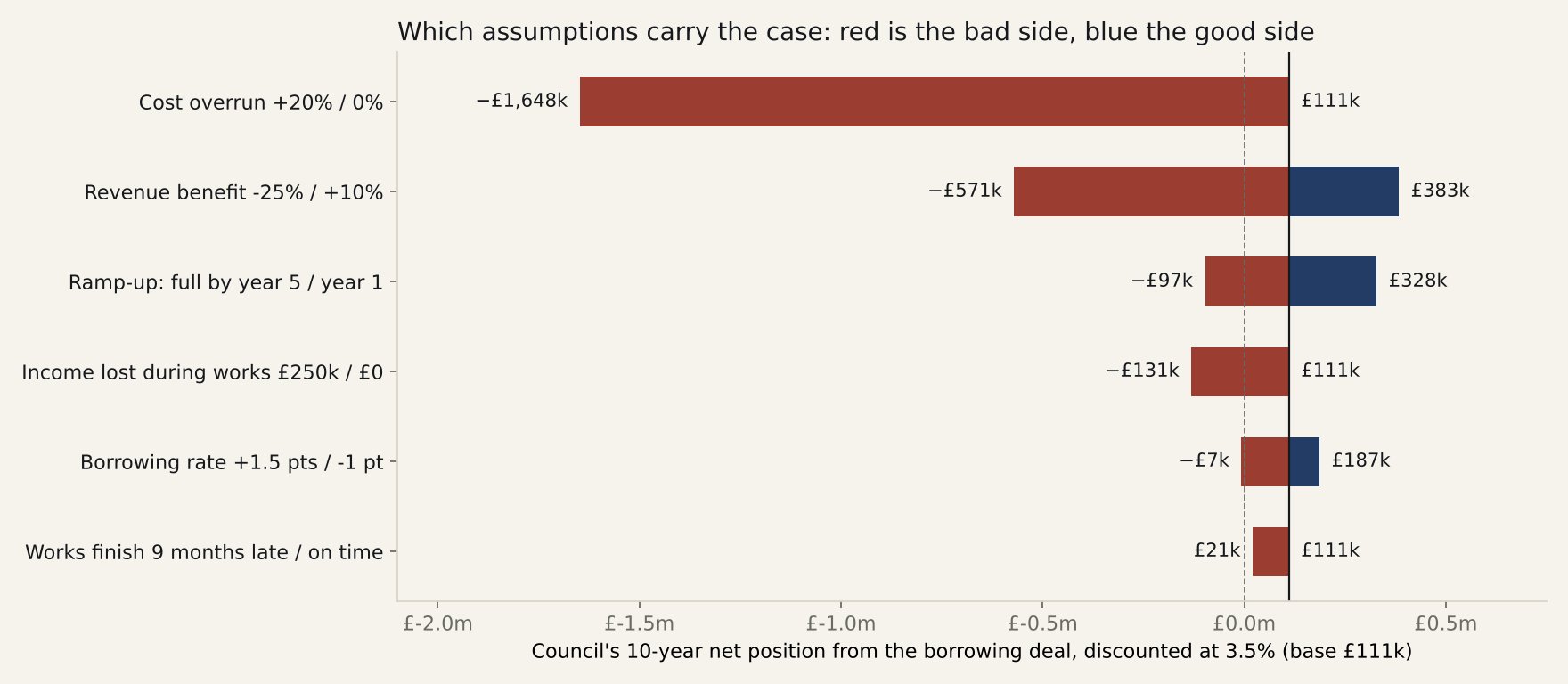
The model was run over the 10 years the case relies on, discounted at 3.5% (the Treasury's standard rate). The return builds up to full by year three, as the case states ("by year three post improvement", E.1), while the loan repayments start straight away.
Base result: the council is £111,000 better off over ten years. Years one and two lose money (£112,000 and £36,000), because the repayments arrive before the full return does. The case does not show this.
Switching values: how far each assumption can move before the council loses money
| Assumption | In the case | Breaks even at (return builds up by year three) | Room to move | Room if the full return arrived in year one |
|---|---|---|---|---|
| Net revenue rise | £370,238 a year | £355,000 a year | 4.1% lower | 10.7% lower |
| Construction cost | £8,358,000 | £8,463,000 | 1.3% higher (£105,000) | 3.7% higher (£312,000) |
| Borrowing rate | about 4.5% | about 5.9% | 1.4 percentage points | 4 percentage points |
The last column is the most generous reading: as if the centre earned its full uplift from the day it reopened. Even then, costs can only rise 3.7%.
- Every £100,000 of cost overrun, if borrowed, costs about £12,600 a year for ten years.
- The case itself puts contingency at "only 5%" (risk R4) and calls the project "relatively high-risk" (A.10). A 5% overrun would put the council in the red on either reading.
- The tornado chart shows a 20% cost overrun would turn a £111,000 gain into a £1.65m loss. A 25% revenue shortfall gives a £571,000 loss.
Step 3: what is missing
Checked against the Treasury's Green Book, the standard every public business case is meant to follow:
- No costed options. The cover report describes a maintenance-only option and a cheaper refurbishment within the existing £6.2m (paragraphs 3.1 and 3.2), but gives neither a cost nor a return. The Green Book expects a "do minimum" option to be appraised with figures, so the board can see what the extra money buys.
- No discounting and no whole-life view. The case uses a simple annual return. There is no net present value, and nothing on what happens after year ten. The case says "no options in this report address the long-term position of the centre" (A.11).
- Optimism bias far below guidance. The Green Book's supplementary guidance starts capital-cost optimism bias at up to 24% for standard buildings and up to 51% for non-standard buildings, before reductions for managed risks. A pool building is non-standard. The case carries 5%.
- Costs named as risks but not costed:
- income lost while parts of the centre are closed (R6)
- replacement office space for the operator (R10: "not currently included and may require additional cost")
- car parking, with only £100,000 allocated (R7)
- the findings of an energy study that had not yet reported (C.11)
- A return that depends on someone else agreeing. The whole repayment rests on the operator's trustees agreeing to hand over the uplift. The case lists this as a high dependency (D1), with no fallback if they do not.
- Inconsistent figures. The cost-certainty stage is £290,000 in sections A.10 and D.7 and £240,000 in section F.1. The recommendation approves borrowing of "up to £2.16 million", but the case only covers £1.488m. Borrowing the full £2.16m would cost about £273,000 a year against a £228,000 return: £45,000 a year worse off.
Step 4: the improvements on their own
The return is presented against the £2.16m above the existing budget. But the existing £6.2m was itself spent partly on improvements:
- Maintenance the project addresses: £2.678m inside the refurbishment, plus £1.48m and £0.42m of further work, so £4.58m.
- The improvements themselves: £8.36m − £4.58m = £3.78m, or £3.11m after the developer and operator contributions.
- Against £3.11m, a £228,000 return pays back in 13.6 years. That is longer than the 10 years of life the refurbishment is meant to buy.
- Discounted over those 10 years, the return is worth about £1.68m against the £3.11m spent: £1.43m short.
What it means: the case looks self-funding because about £1.6m of the improvement cost sits in an existing maintenance budget and is not charged to the project. That may still be the right decision, since the health and community benefits are real and not priced. But the board should have been shown it in those terms.
What happened next (public record)
- December 2024: Cabinet recommended going ahead with the additional £2.16m. It noted that one-off costs, "such as income losses during centre disruption and reprovision service costs", would come from a reserve. Those are exactly the costs missing from the July case.
- Timetable: the case planned works "in 2025" with completion by January 2026 (F.5). The council later announced a start in November 2025 and completion in October 2026. That is nine months later, which puts the return back nine months while the money is already committed.
- A decarbonisation grant was later secured for heat pumps. That is an upside the case did not count.
What the board should have asked
- What does the maintenance-only option cost, and what does the extra £3.8m buy over it?
- Show us years one and two, not just year three.
- With 5% contingency on a 49-year-old pool building, what happens at 15% or 20%?
- Revenue only has to fall 4%, or costs rise just over 1%, before we lose money. What evidence makes us confident neither will happen, and can we see the independent revenue report in confidence?
- What happens if the operator's trustees will not commit the return?
- Where is the plan for the centre after year ten?
How I would run this for a client
- What you provide: the business case and model, before the decision if possible.
- What you get: a rebuilt model that ties to yours, the switching values, a tornado chart, a Green Book gap check and the questions your board should ask, all in about ten pages.
- How long: five to ten working days. Fixed fee, agreed when we scope it.
- Who it is for: boards, investment committees, scrutiny committees, lenders and bidders who want to know where their own case breaks before someone else finds it.
Limits
- Only published material was used. The independent market review (an exempt appendix) was not available, so the revenue forecast is tested for sensitivity, not second-guessed.
- The ramp-up profile (one-third in year one, two-thirds in year two) is my reading of "by year three". The full-return-from-year-one figures are given alongside: the ten-year gain would be £328,000 instead of £111,000, and the switching values are in the last column of the table.
- Cost overruns are assumed to be borrowed on the same terms. If the council funds them from reserves, the cash effect is the same; only the timing differs.
- The benefits to health and wellbeing are real and are not valued here, or in the case.
Hostile self-audit
- "The arithmetic is fine, so where is the problem?" Exactly. The pack says the arithmetic reproduces, then shows how little room the assumptions leave.
- "Isn't the £3.78m improvement figure your invention?" It is the case's own numbers: total works less the maintenance the case says it addresses (C.9 and E.1).
- "Tone." No criticism of officers or members. Every challenge cites a section of the original document.
Sources
- The council's full business case (July 2024) and cover report to Council, from its committee papers (downloaded 9 October 2026)
- Cabinet decision of 10 December 2024, via opencouncil.network
- The council's announcement of the works programme, October 2025
- HM Treasury, The Green Book (2022) and Supplementary Green Book Guidance: Optimism Bias, Table 1: https://www.gov.uk/government/publications/the-green-book-appraisal-and-evaluation-in-central-government
The council, its operator and its development partner are anonymised on the public site. The working files name them, because the documents are public.